Can You Buy a House With No Credit Score?
In this article
"Yes, you can buy a house with no credit score, but the lender has to prove you pay your bills another way. Fannie Mae has written rules for loans where no borrower has a credit account, and FHA allows borrowers with ""non-traditional or insufficient credit"" as long as the loan is manually underwritten. In both cases, expect to show a steady record of payments such as rent, utilities or insurance.
This guide explains how lenders look at buyers with no credit, the paperwork they ask for, and the FHA change coming for case numbers assigned on or after Jan. 1, 2027. Every rule was checked Nov. 25, 2026.

Can you really get a mortgage with no credit score?
You can, and you are not alone. The Consumer Financial Protection Bureau (CFPB) estimated in a June 2025 update that 2.7% of U.S. adults, about 7.0 million people, were ""credit invisible"" in December 2020. That means they had no credit record at the national credit bureaus.
Having no credit is not the same as having bad credit. It just means the usual score is missing, so the lender needs other proof that you pay on time. That proof is called nontraditional credit.
What counts as nontraditional credit?
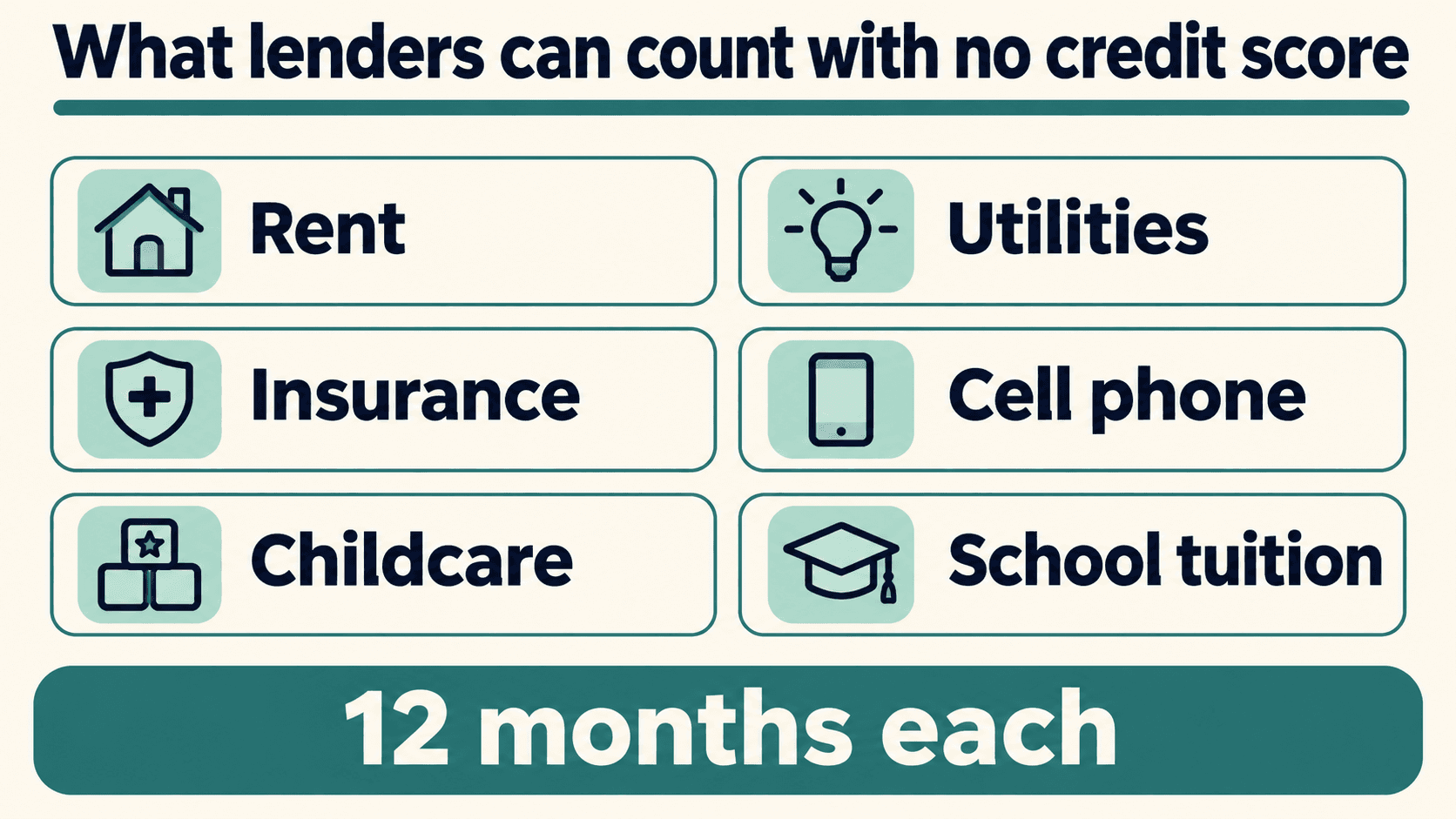
Fannie Mae's Selling Guide section B3-5.4-02 (dated Feb. 4, 2026) lists the kinds of payments lenders can use. They include:
Rent paid to a landlord or property management company
Utilities such as electricity, gas, water, phone, TV and internet
Property, renter's or auto insurance payments
Cell phone payments
Childcare payments
School tuition payments
Fannie Mae says the payment history for each reference must cover ""the most recent consecutive 12-month period."" It also says all credit references must be included, ""not just those that reflect acceptable performance."" So a late payment cannot simply be left out.
How does Fannie Mae handle a buyer with no credit score?
Fannie Mae has two paths, set out in section B3-5.4-01 (dated Nov. 5, 2025).
Path 1: Desktop Underwriter (DU). When no borrower has at least one credit account or installment account on their credit report, Fannie Mae says DU applies these rules:
The home must be a one- to four-unit principal residence, and all borrowers must live in it.
The loan must be a purchase or a limited cash-out refinance.
Reserves may be required, as DU decides.
A nontraditional credit history must be documented for each borrower as DU instructs.
Fannie Mae adds that no verification of nontraditional credit references is required for any borrower when DU does a ""cash flow assessment"" and says a third-party asset verification report may be used.
Path 2: Manual underwriting. When one or more borrowers has no credit score and the loan is underwritten by hand, Fannie Mae says:
The maximum debt-to-income ratio is 36%.
The home must be a one-unit principal residence.
The loan must fit the baseline loan limits. High-balance loans are not eligible.
There is no minimum reserve requirement if at least one borrower can document a housing payment history. Otherwise, at least 12 months of reserves are required.
Each borrower without a credit score needs four credit references, or three on a HomeReady loan.
Our guide to HomeReady income limits explains that program.

Can rent payments help me qualify?
They can. Fannie Mae says DU can use asset verification reports to consider rent payment history. Lenders confirm ""12 months of positive rent payment data,"" the rent amount entered on the application must match the withdrawals shown in the report, and the lender must explain the process and get your consent before ordering the report.
The practical step: pay your rent from your bank account, the same amount each month, so the history shows up clearly.
How does FHA treat a buyer with no credit score?
FHA, the loan program run by the U.S. Department of Housing and Urban Development (HUD), spells this out in Mortgagee Letter 2026-11, dated Oct. 8, 2026. It says borrowers with ""non-traditional or insufficient credit histories are eligible for maximum financing"" but must be underwritten using FHA's manual underwriting procedures.
The same letter says transactions with a minimum decision credit score below 580, or with no credit score, ""may not exceed 31/43 ratios."" In plain words, your housing payment can be up to 31% of your income and your total monthly debts up to 43%, as your lender figures them under FHA's rules.
Here is a side-by-side view of the rules above:
Rule | Fannie Mae (DU, no credit account) | Fannie Mae (manual, no score) | FHA (no score) |
|---|---|---|---|
Who reviews the loan | DU | A human underwriter | A human underwriter |
Home type | 1–4 unit principal residence | 1-unit principal residence | Per FHA rules |
Debt-to-income limit | Set by DU | 36% | 31% housing / 43% total |
Payment history | As DU instructs | 4 references, 12 months each | Per FHA manual underwriting |
Reserves | As DU decides | None with housing history, else 12 months | Per FHA manual underwriting |
What changes at FHA on Jan. 1, 2027?
Mortgagee Letter 2026-11 says FHA is adopting two newer credit score models, FICO 10T and VantageScore 4.0, ""alongside Classic FICO."" HUD says these models ""also leverage non-traditional credit like rent and utilities.""
Three points from the letter matter to buyers:
It applies to FHA loans with case numbers assigned on or after Jan. 1, 2027.
FHA says the existing minimum credit score thresholds ""remain unchanged regardless of Credit Score Model Type.""
A loan is not eligible for FHA insurance if the minimum decision credit score is below 500, and scores from 500 to 579 are limited to a maximum loan-to-value of 90%.
So a buyer who had no score under the older model may be scored under a newer one in 2027. Whether you get a score, and what it is, depends on your own file. Our FHA vs conventional guide compares the two loan types.
How can I build a credit file before I buy?
If you are a year or more away from buying, a few steady habits make the lender's job easier:
Keep paying rent, utilities and insurance on time, ideally from one bank account.
Save every lease, receipt and statement for the last 12 months.
Keep your bank balance steady so savings for the down payment and reserves are easy to see.
Ask a lender early which path fits you, so you know what to collect.
Our guide to what credit score you need to buy a house covers the score side once you have one.
What this means for new-construction buyers
Buying a home that is still being built adds two timing points:
Your 12 months keep moving. Fannie Mae wants the most recent consecutive 12 months of each payment history. On a long build, expect your lender to ask for newer records before closing.
FHA's case number date matters. Mortgagee Letter 2026-11 applies to case numbers assigned on or after Jan. 1, 2027. If you plan an FHA loan on a home that closes next year, ask your lender when your case number will be assigned and which rules apply.
Get pre-approved before you sign a builder contract, so you know your path and budget first. Our post on getting pre-approved explains the steps. For help on a specific new home, call 561-704-0091 for today's numbers.

Common Questions
Can I buy a house with no credit score?
Yes. Fannie Mae has rules for loans where no borrower has a credit account, and FHA allows borrowers with non-traditional or insufficient credit if the loan is manually underwritten.
What is nontraditional credit?
It is a record of regular payments that do not show on a credit report, such as rent, utilities, insurance, cell phone, childcare or school tuition. Fannie Mae wants the most recent consecutive 12 months for each one.
How many credit references do I need with no credit score?
For a manually underwritten Fannie Mae loan, each borrower without a credit score needs four references, or three on a HomeReady loan.
What is the debt-to-income limit with no credit score?
Fannie Mae's limit is 36% on a manually underwritten loan with nontraditional credit. FHA says a loan with no credit score may not exceed 31/43 ratios.
Can rent payments help me get a mortgage?
Yes. Fannie Mae says DU can use asset verification reports to consider rent payment history, and lenders confirm 12 months of positive rent payment data with your consent.
What is FHA changing on Jan. 1, 2027?
FHA Mortgagee Letter 2026-11 adds FICO 10T and VantageScore 4.0 alongside Classic FICO for case numbers assigned on or after Jan. 1, 2027. FHA says its minimum credit score thresholds stay the same.
Ready to take the next step?
Call 561-704-0091 to talk with a National House Search specialist, or Schedule a visit.
Related reading: Credit score needed to buy a house · FHA vs conventional loan · Homebuyer education course
This is general information, not financial, tax or legal advice. Figures checked November 25, 2026."