Townhouse vs. Single-Family Home: What's Really Different
In this article
Most townhouse-vs-single-family comparisons online are written in generalities, because most communities only sell one or the other. Blossom Trail sells both, on the same gated site, from the same builder, with the same warranty and largely the same finish package—which means we can actually answer this question with real numbers instead of vague trade-offs.
The core difference: attached vs. detached
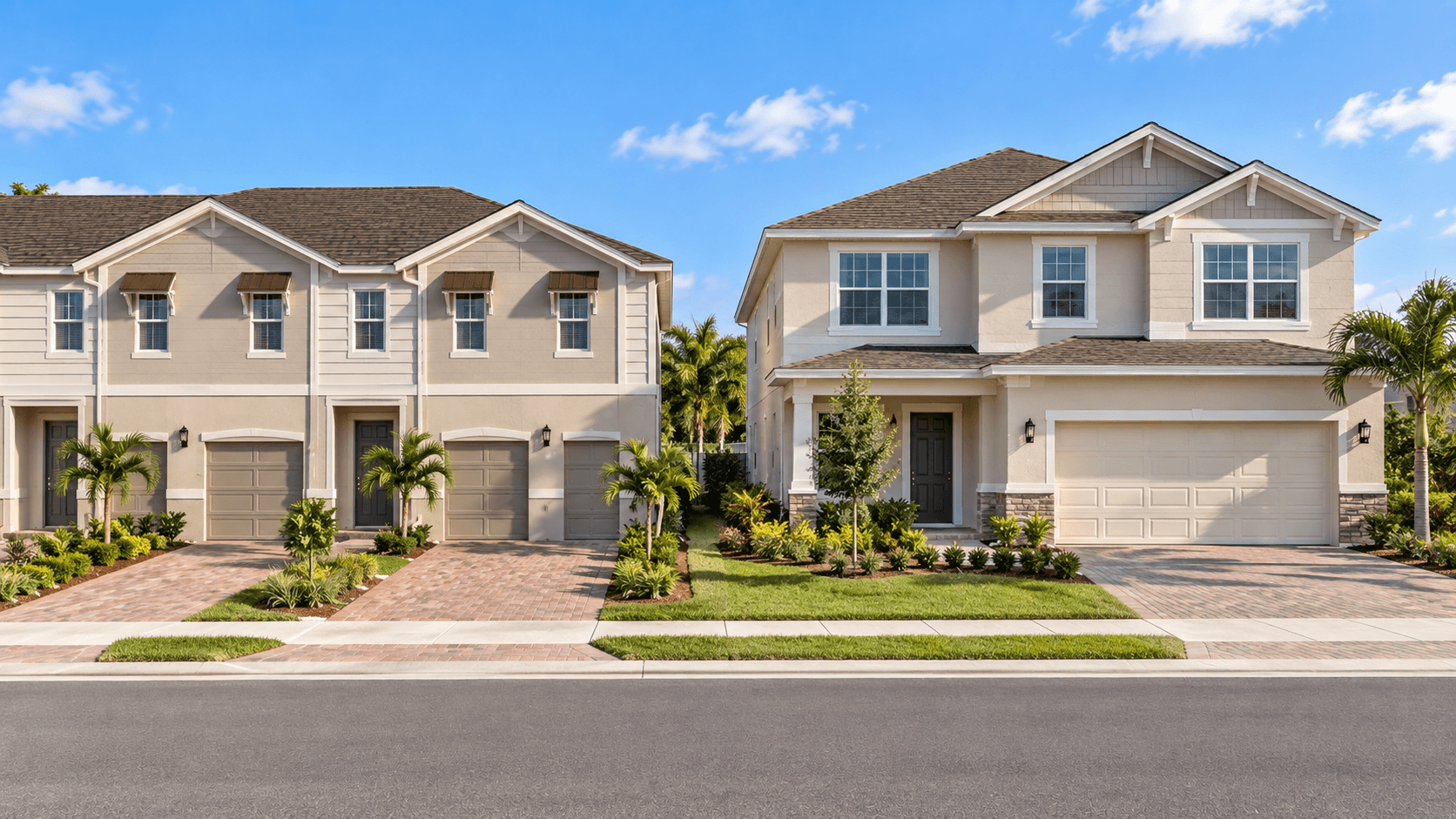
A townhouse shares at least one wall with a neighboring home. A single-family home stands completely on its own, with no shared walls. At Blossom Trail, Bella and Terra are the two townhomes; Delray, Robie, and Ponte Vedra are the three single-family homes. That's the entire structural difference—everything else below is really a downstream effect of that one fact.
Size: a real gap, not a small one
At Blossom Trail specifically, the size difference between the two home types is substantial. The townhomes run about 1,446 to 1,472 square feet. The single-family homes start at about 2,034 square feet for the smallest plan, Delray, and go up to about 3,072 square feet for the largest, Ponte Vedra. Even the smallest single-family home here is about 40% larger than the bigger of the two townhomes.

That's a bigger gap than some communities offer, where townhomes and single-family homes sit closer in size. Here, choosing between the two home types is really choosing between two different scales of home, not just a different architectural style at a similar size.
Price: what the size gap costs
That size difference shows up directly in price. Townhomes at Blossom Trail have recently started around the high $400,000s. Single-family homes start around the high $600,000s for the Delray and run up to the high $700,000s for the Ponte Vedra. Call 561-704-0091 for current numbers, but as a rule of thumb here, moving from a townhome to the smallest single-family plan is roughly a $200,000 jump.
Garage and outdoor space
Townhomes at Blossom Trail come with a 1-car garage and a small patio, about 7' by 5'. Single-family homes all include a 2-car garage and meaningfully more outdoor space—Delray's lanai alone runs about 23'4" by 9'4", several times the size of either townhome's patio. If garage storage or outdoor living space matters to your day-to-day life, that's a real, measurable difference here, not a marginal one.
What's the same either way?
This is worth knowing because it changes the calculation: the finish package is nearly identical across both home types at Blossom Trail. Both get 2CM granite kitchen countertops, 2CM quartz bathroom countertops, impact-resistant glass on every window, and D.R. Horton's Home Is Connected smart home system. Both carry the exact same builder warranty—1-year workmanship, 2-year systems, 10-year structural, and a 10-year limited HVAC warranty from Carrier.

The one real feature gap runs the other direction from what people often assume: the townhomes include a tankless water heater standard, and the single-family homes don't. So a buyer choosing the smaller, less expensive townhome isn't actually settling for lower-quality finishes—they're getting essentially the same materials and the same warranty, in a smaller footprint with a shared wall, at a meaningfully lower price.
HOA and maintenance
Blossom Trail has an HOA that covers both home types, handling landscaping in common areas and other shared responsibilities. Exactly what falls to the homeowner versus the association can vary between the townhome and single-family sections of a community, and it's worth asking specifically rather than assuming—that's the kind of detail best confirmed directly rather than published broadly here.
Privacy and noise
A shared wall is the one trade-off that doesn't show up on a spec sheet. Modern construction, including the impact-rated components used throughout Blossom Trail, manages sound reasonably well, but a townhome buyer should still expect a neighbor on the other side of at least one wall—something a single-family buyer simply doesn't have to think about. For some households that's a non-issue; for others, especially light sleepers or families with young children on different schedules, it's worth touring a townhome at a couple different times of day before deciding.
Single-family homes also offer more flexibility for future changes—adding a fence, landscaping a private yard, or simply having exterior walls that belong entirely to you rather than a shared structure. Townhome owners typically have less latitude here, since exterior appearance is often governed collectively through the HOA to keep the community looking consistent.
Who actually fits each type?
A townhome at Blossom Trail tends to suit a first-time buyer stretching to get into new construction at all, a couple without children who doesn't need extra bedrooms, or anyone who values a lower-maintenance footprint over maximum space. A single-family home tends to suit a growing family that needs more bedrooms and a real yard-adjacent lanai, or a buyer who has the budget and specifically wants the extra privacy of a detached home with no shared walls.
So which one actually makes sense?
If budget is the primary constraint, or if you want the lowest-maintenance option with the smallest footprint to take care of, the townhomes are the clear answer—Bella or Terra, depending on how much bedroom space you need. If you have the budget for it and want real separation from neighbors, a private garage bay for two vehicles, and meaningfully more indoor and outdoor space, the single-family plans are worth the jump, and Delray, Robie, or Ponte Vedra each fit a different version of that need.
The genuinely useful thing about a community like Blossom Trail is that you don't have to guess at this trade-off in the abstract—you can walk a townhome and a single-family home twenty minutes apart on the same site and feel the size difference directly, rather than trying to compare two communities across town from memory.
Common Questions
What's the main difference between a townhouse and a single-family home?
Whether the home shares a wall with a neighboring unit. Townhouses are attached; single-family homes stand alone.
Are townhomes cheaper than single-family homes at Blossom Trail?
Yes, meaningfully so -- townhomes have recently started around the high \$400,000s, while single-family homes start around the high \$600,000s.
Do the townhomes and single-family homes have the same finishes?
Nearly identical -- both include the same granite and quartz countertops, impact glass, and smart home system. The townhomes additionally include a tankless water heater that the single-family homes don't.
Do single-family homes have bigger garages?
Yes -- all three single-family plans include a 2-car garage, versus a 1-car garage on both townhome plans.
Is there an HOA for both home types?
Yes, Blossom Trail has an HOA that applies community-wide. Specific responsibilities are best confirmed directly.
Which is bigger, the smallest single-family home or the biggest townhome?
The single-family home. Even Delray, the smallest single-family plan at about 2,034 square feet, is significantly larger than Terra, the bigger of the two townhomes at about 1,472 square feet.
Walk a townhome and a single-family home on the same visit: Schedule a visit to Blossom Trail or call 561-704-0091.
Compare the two townhomes directly in Bella vs. Terra, or the three single-family plans in Delray vs. Robie vs. Ponte Vedra. New to the term? Start with what is a townhouse? And for the finish details covered here, see quartz vs. granite countertops.