Cinder Block House or Frame? How Harmony's Two-Story Homes Are Built
In this article
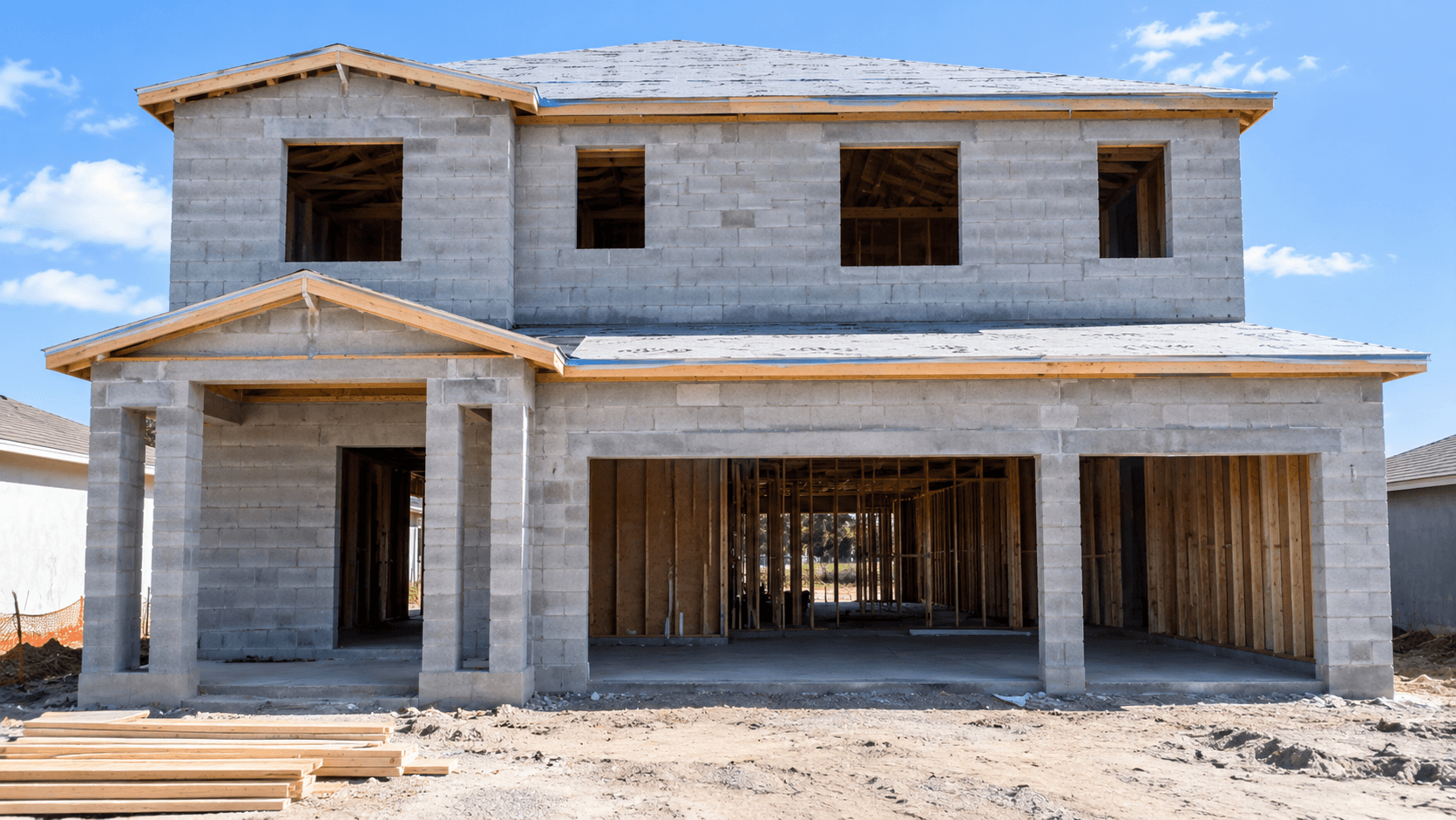
A cinder block house is what many people call a home with concrete block walls. At Harmony at Lake Eloise in Winter Haven, D.R. Horton lists ""block on block construction"" and ""Two Story Concrete Block Construction."" That matters most for the seven two-story plans. This guide explains what the terms mean, which Harmony plans have two stories and what to ask before you buy.

Cinder Block House vs. Concrete Block House: Same Thing?
Mostly, yes. The blocks used in homes today are concrete masonry units, often shortened to CMU. In the United States, people often call them cinder blocks.
The nickname comes from the past. Some blocks were made with cinders, such as fly ash or bottom ash, mixed into the concrete. That is why the name stuck. Today the words ""cinder block"" and ""concrete block"" are used to mean the same kind of wall in everyday talk.
So when you hear a sales rep, an inspector or a neighbor say ""cinder block house,"" they almost always mean a home with concrete block walls.
What D.R. Horton Says About Harmony's Construction
Here is the builder's own wording from the Harmony at Lake Eloise page:
""Built with long lasting quality in mind, homes feature block on block construction, architectural shingles, and timeless stucco exteriors.""
The builder's amenity list also includes ""Two Story Concrete Block Construction.""
You can see the full community on our Harmony at Lake Eloise page.
What ""Block on Block"" Usually Means
Some two-story homes in Florida are built with concrete block on the first floor and wood framing on the second. In home sales, ""block on block"" is often used for a home where the second floor is block too.
D.R. Horton's wording points to that build for Harmony. Still, ask the sales team to confirm it for the exact plan you want, and ask to see it in writing or on the plans. A one-line question now saves a guess later.
Which Harmony Plans Are Two Stories?
Seven of Harmony's 18 plans have two stories. These are the plans where block on block matters most:
Plan | Beds | Baths | Garage | Sq. ft. |
|---|---|---|---|---|
Glen | 3 | 2.5 | 1 | 1,673 |
Vale | 3 | 2.5 | 1 | 1,758 |
Crestview | 4 | 2.5 | 2 | 1,866 |
Riviera | 4 | 3 | 2 | 2,215 |
Campbell | 4 | 2.5 | 2 | 2,308 |
Robie | 5 | 3 | 2 | 2,447 |
Hayden | 5 | 3 | 2 | 2,601 |
The other 11 plans are one story, so every wall is on the ground floor anyway. To see all 18 plans side by side, read our Harmony floor plan comparison.

Two Stories in Block vs. One Story: The Trade-Off
If block construction is high on your list, you have two paths at Harmony.
Go one story. Every one-story plan is built on the ground floor, so all of its outside walls sit on the slab. You also skip stairs. The trade-off is price. On D.R. Horton's site, the largest one-story plan, the Camden, starts in the $470,000s.
Go two stories. The two-story plans give you more space for less money. The Hayden, the largest two-story plan, has five bedrooms in 2,601 square feet and starts in the $350,000s. With block on block construction, you do not have to give up a block second floor to get that space, as long as the builder confirms it for your plan.
For many buyers, that is the deciding point. If stairs are fine for your household, a two-story block home can stretch your budget further.
Why Buyers Ask for Block Construction
Buyers in Florida often prefer block walls. Here are the reasons people give most:
Solid feel. Block walls feel heavy and sound solid when you knock on them.
No wood in the outside walls. Block does not rot the way wood can when it gets wet.
Familiar to Florida buyers. Many Florida homes are block, so it is what a lot of buyers expect.
Here is the honest part. A block home still has wood or metal in it. Roof framing, interior walls, door frames and cabinets are not block. So a block home is not ""wood-free,"" and it still needs normal care.
Things to Know About Living in a Block Home
A few everyday things work a little differently in a block home:
Hanging heavy items. On block walls, you need masonry anchors and the right drill bit. Interior walls may be different, so check what is behind the wall first.
Running new wires. Adding outlets on an outside wall takes more work than in a wood-framed wall.
Stucco care. Harmony's homes have stucco exteriors. Small hairline cracks in stucco are common. Point out anything that looks wider than a hairline during your walkthrough or warranty visits.
Block Construction and Insurance
Insurance companies look at how a home is built when they set a price. Building materials, the roof and the windows can all play a part. Ask your insurance agent how a block home with a newer roof is rated, and get a quote before you sign.
Our guide to whether new homes cost less to insure in Florida explains how building code and wind mitigation forms can affect your rate.
Check the Build Before the Walls Close
A block house is only as good as the work that goes into it. If you are buying a home that is still being built, think about a pre-drywall inspection. That is a check of the framing, wiring and plumbing before the inside walls are covered.
Our pre-drywall inspection checklist covers what an inspector looks at and when to schedule one. For another look at how D.R. Horton builds with block, see our guide to the concrete block homes at Baywood II.
Block Is One Part of the Feature List
Construction is only one piece of what comes with a Harmony home. D.R. Horton also lists shaker cabinets, stainless steel Whirlpool appliances, luxury vinyl flooring and smart home technology. Our walk-through of Harmony's included features covers each item, the 1-2-10 warranty and how buying works.
If you are also weighing the lake, our guide to life near Lake Eloise covers the boat slips D.R. Horton describes and the questions to ask about them.
Questions to Ask the Sales Team
Bring this list to your visit:
Is my plan block on both floors?
What is the roof made of, and how is it attached?
What kind of windows come standard?
Can I get a copy of the plans or the features sheet?
Can my own inspector visit during construction?
On D.R. Horton's site, the two-story plans start from the high $200,000s to the $370,000s. Call 561-704-0091 for today's numbers.

Common Questions
Is a cinder block house the same as a concrete block house?
In everyday talk, yes. Modern blocks are concrete masonry units, and in the United States they are often called cinder blocks.
Are Harmony at Lake Eloise homes block construction?
Yes. D.R. Horton lists block on block construction and two-story concrete block construction at Harmony.
What does block on block mean?
It usually means a two-story home where the second floor is block too, not wood frame. Ask the builder to confirm it for your plan.
How many two-story plans are at Harmony?
Seven: the Glen, Vale, Crestview, Riviera, Campbell, Robie and Hayden.
Do block homes still have wood in them?
Yes. Roof framing, interior walls, door frames and cabinets are usually not block, so a block home still needs normal care.
Should I get an inspection on a new block home?
Yes. A pre-drywall inspection and a final inspection can catch problems before you close.
Tour the Two-Story Plans
Call 561-704-0091 or set up a time to see Harmony at Lake Eloise. We will help you check how your plan is built.
Related reading: Shaker Cabinets and What's Included at Harmony at Lake Eloise · Lake Eloise: What Harmony Buyers Should Know · House Plans With 3 Car Garage at Harmony at Lake Eloise