What Is New Urbanism? Explained at The Domaine at SoSo
In this article
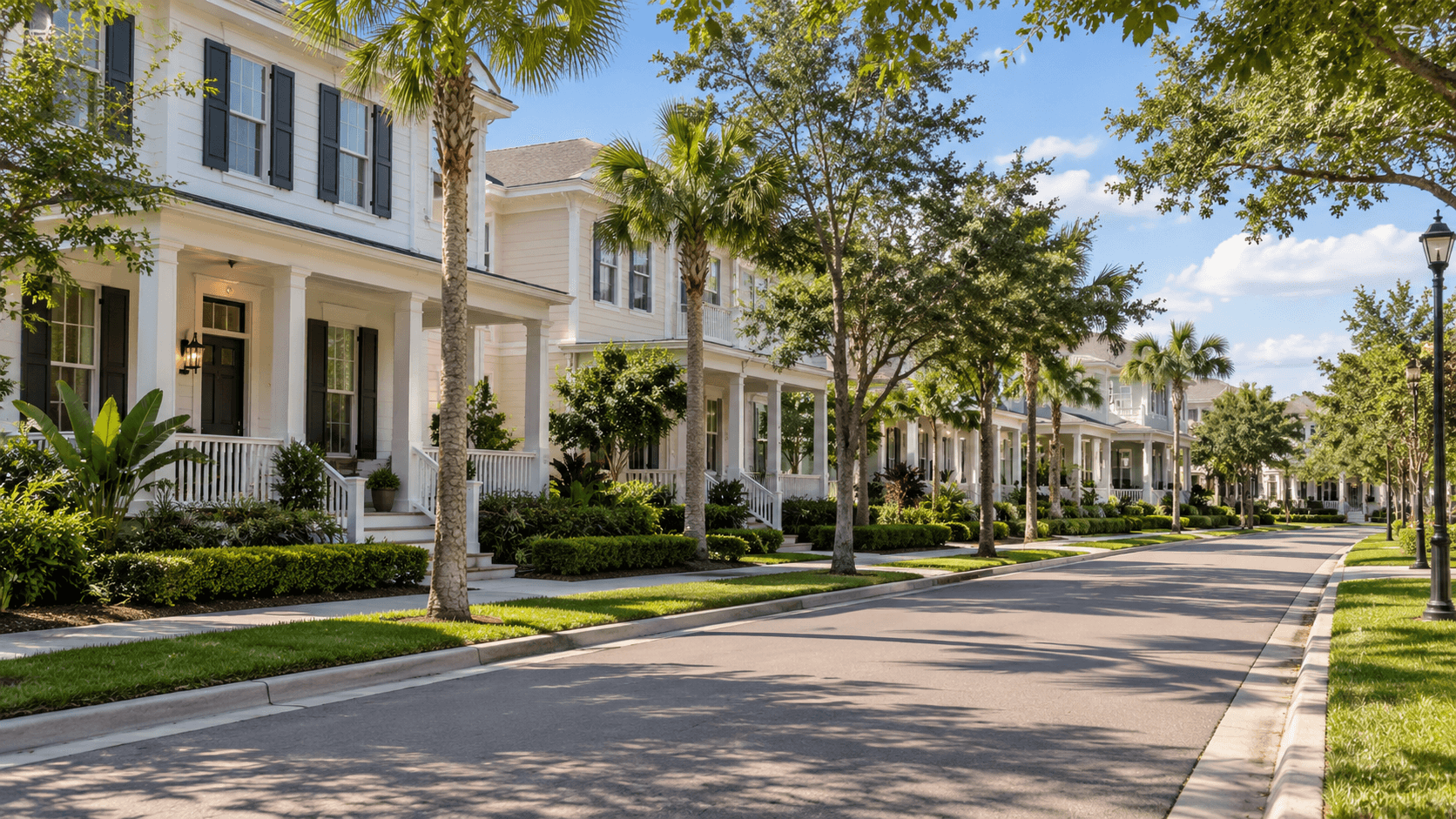
Walk down the street at The Domaine at SoSo, and you won't see garage doors — you'll see front porches. That's not an accident. It's called New Urbanism, and it's a design approach that flips the usual suburban layout: the street belongs to people, not driveways.

The basic idea
In a typical suburban townhome row, the garage door is often the most prominent thing you see from the street — it usually sits at the front, closest to the road. New Urbanism design does the opposite: the front door and porch face the street, and the garage is tucked around back, reached by a separate access road.
The goal is to make the street itself feel like a place people actually use—for walking, for saying hello to a neighbor on a porch, for a kid riding a bike—rather than just a corridor of driveways and garage doors.
How this plays out at The Domaine at SoSo
Both the Marlow and Saltwater plans follow this layout. Park in the garage, which sits off a landscaped interior road at the back of the community, and walk around to a front door and porch that face the street like a traditional single-family neighborhood. It's a small detail, but it changes how the community actually feels to walk through, compared to a typical townhome row.

Where this idea comes from
New Urbanism as a planning philosophy has been around since the late 20th century, built around walkable blocks, front porches, and a street grid that prioritizes people over cars. It shows up in townhome and rowhouse design specifically through this porch-forward, garage-in-back layout — a callback to how many American neighborhoods were actually built before the mid-1900s, when cars and garages started dictating street design.
Does it change day-to-day living?
In practical terms: yes, a little. You'll walk a few extra steps from the rear garage to your front door most days. In exchange, the street-facing side of your home is a porch, not a garage door, which matters if you like sitting outside or just prefer a more neighborhood feel to the street you live on.

A side-by-side comparison
Picture a standard suburban street: garage doors dominate the view, driveways cut into the sidewalk, and the front of most homes is really the side of a garage. Now picture a New Urbanism street: porches, front doors, maybe a tree line, and no cars in sight from the road, because they're all parked around back. Same number of homes, same basic square footage—a genuinely different feel to walk or drive down.
What this means for everyday logistics
Trash and recycling pickup, mail delivery, and deliveries in general typically route through the rear access road alongside the garages, not the front porches—similar to how alley-loaded neighborhoods have worked for decades in older American cities. It's worth asking exactly how trash day and package delivery work at The Domaine at SoSo specifically, since the answer can vary by builder even within the same general layout style.
The bigger planning picture
New Urbanism isn't just a garage placement trick—it's a broader planning philosophy that also emphasizes mixed building types, a connected street grid instead of cul-de-sacs, and public space that's actually used rather than just landscaped. Most of that broader philosophy shows up at the scale of an entire town or master plan, not a single 30-home community. What The Domaine at SoSo borrows from it is specifically the porch-forward street design—a small-scale application of a much larger idea.
New Urbanism and Safety
One argument in favor of this layout is sightlines—with porches facing the street instead of garage doors, there are simply more windows and more eyes on the street from people's living spaces, which some residents feel adds a sense of everyday awareness of who's around. This is anecdotal rather than a guaranteed outcome, and it shouldn't replace asking about the community's own security features, like gating and any monitoring the HOA provides.
How this affects curb appeal and resale
Because the street-facing side of every home shows a porch rather than a garage door, a New Urbanism street can photograph and show differently than a typical townhome row—which some buyers and agents point to as a resale advantage, since it reads more like a traditional single-family street from the curb. Whether that translates into a measurable price difference depends heavily on the specific market and comparable sales and isn't something to assume without checking local data.
A brief historical parallel
Before car ownership became universal in the mid-20th century, most American neighborhoods were built with something close to this same porch-forward, walkable logic by default—garages, when they existed at all, were often detached and set back. New Urbanism, as a modern planning movement, is in many ways a deliberate return to that older pattern rather than an entirely new invention, which is part of why streets built this way can feel more "traditional" even though the homes themselves are brand new.
A question worth asking on your visit
If the porch-forward layout is new to you, it's worth actually standing on one during a visit and picturing your own routine—morning coffee, greeting a neighbor, watching kids play—rather than just reading a floor plan on paper. The layout is easier to evaluate in person than in the abstract, and sales consultants are used to walking buyers through exactly how the daily flow works. Ask your sales consultant whether any current residents are available to speak with about how the layout has worked in practice—a firsthand account from someone actually living with a rear-loaded garage can be more useful than any brochure description.
It's a small design choice with an outsized effect on how a street feels to live on—worth experiencing in person rather than judging from a site plan alone.
Common Questions
Is New Urbanism the same as "walkable" design?
They're related but not identical. Walkability is one goal of New Urbanism, but the philosophy also covers things like street layout, porch placement, and mixed building types within a neighborhood.
Does every home at The Domaine at SoSo have this layout?
Yes — both the Marlow and Saltwater plans put the front door and porch on the street, with garage access off the rear interior road.
Is this layout harder to get used to than a standard townhome?
Most buyers adjust quickly — it just means parking and walking to your front door from a different direction than a typical garage-in-front townhome. Ask to walk the community in person to get a feel for it.
Why don't more communities build this way?
It generally costs more to design and build a rear access road and separate garage structure than a standard front-loaded garage, so it's less common in larger, price-focused subdivisions.
Is New Urbanism a new trend?
The planning philosophy dates back decades, though it's applied selectively — most new residential construction in Florida still uses a standard front-loaded garage layout.
See the layout in person. See The Domaine at SoSo or call 561-704-0091.