Mortgage Gift Letter: What It Must Say and Who Can Give You Down Payment Money
In this article
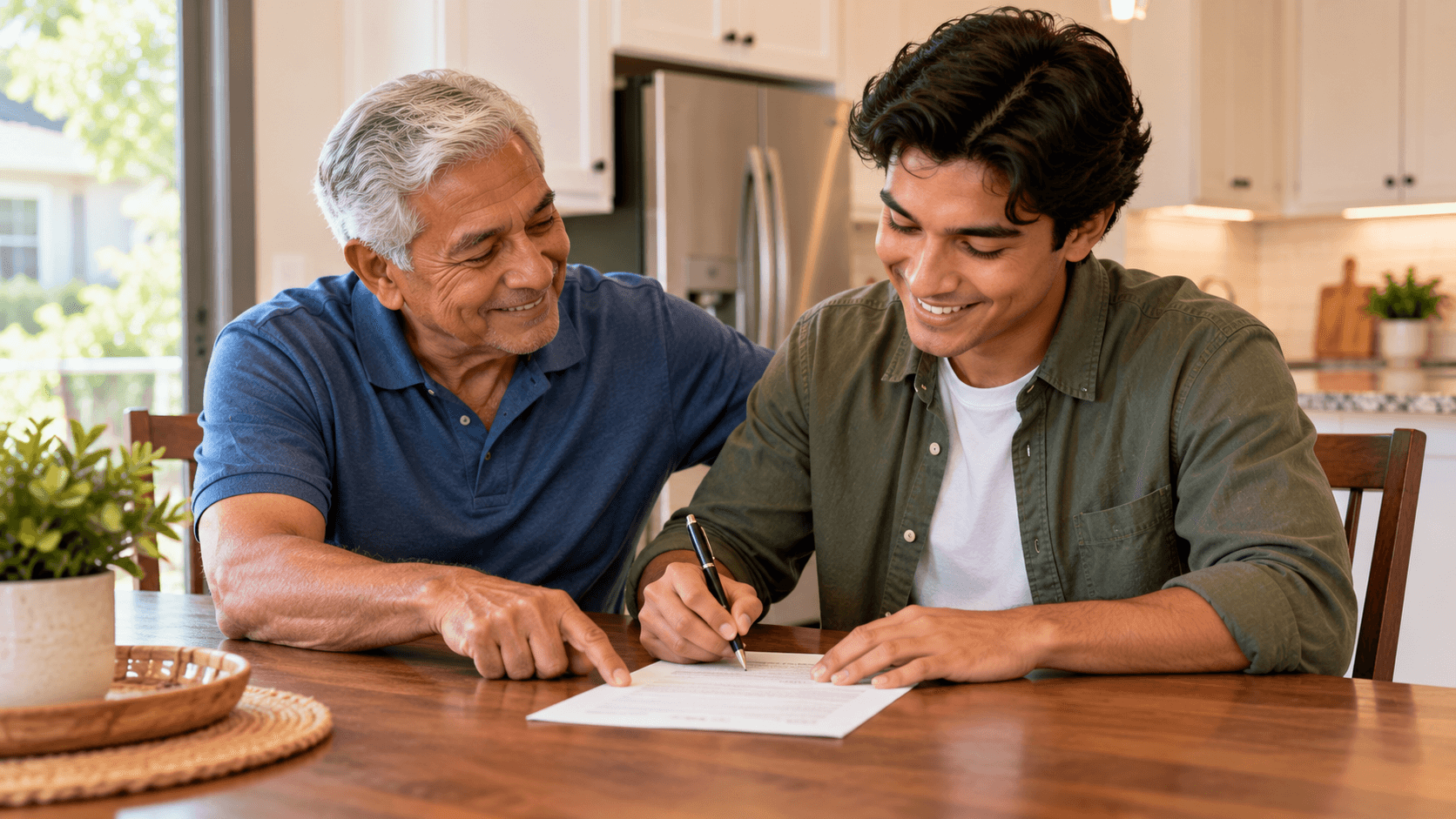
A mortgage gift letter is a signed note from the person giving you money for your home. It says how much they are giving, that you never have to pay it back, and who they are. For a conventional loan backed by Fannie Mae, a qualifying relative or close family-like donor can cover your entire down payment on a one-unit home you will live in, as long as the gift is documented the right way.
What is a mortgage gift letter?
Lenders have to know where your down payment comes from. The Consumer Financial Protection Bureau (CFPB) says lenders ""are generally required to verify the source of your income and down payment funds."" When some of that money is a gift, the gift letter is the proof that it is truly a gift and not a hidden loan.
The CFPB's down payment page (last reviewed April 3, 2024) puts it simply: for some loans, gifts can be used as down payments, as long as you can prove where the money came from, and you may need to ""submit a signed statement saying the money is a gift and not a third-party loan.""

What must a gift letter say?
Fannie Mae's Selling Guide (section B3-4.3-04, Personal Gifts, dated Feb. 4, 2026) says the gift letter must be signed by the donor and must:
State the amount. It must ""specify the actual or the maximum dollar amount of the gift.""
Say no repayment is expected. It must include ""the donor's statement that no repayment is expected.""
Identify the donor. It must ""indicate the donor's name, address, telephone number, and relationship to the borrower.""
Many lenders have their own gift letter form. Use theirs if they give you one.
Sample mortgage gift letter (fill-in example)
Here is a plain example that covers the three items above. It is a starting point, not a legal form:
I, [donor's full name], am giving [buyer's full name] a gift of $[amount] to use toward the purchase of the home at [address or ""a home to be purchased""]. No repayment of this gift is expected or required, now or in the future. I am the buyer's [relationship]. My address is [address] and my phone number is [phone]. Signed: [donor signature] Date: [date]
Who can give you money for a down payment?
Fannie Mae allows gifts from a relative, which it defines as your ""spouse, child, or other dependent,"" or anyone ""related to the borrower by blood, marriage, adoption, or legal guardianship.""
It also allows people who share a family-like bond: a ""domestic partner (or relative of the domestic partner), individual engaged to marry the borrower, former relative, or an individual with a long-standing familial-like or mentorship relationship with the borrower.""
Here is the rule new-construction buyers need most. Fannie Mae says the donor ""may not be, or have any affiliation with, the builder, the developer,"" or ""any other interested party to the transaction."" So a builder can never be your gift giver.
Other loan types have their own rules:
FHA loans: HUD's FHA handbook (Handbook 4000.1) has its own section on gifts, both personal and equity, with its own paperwork rules. HUD updated its guidance on documenting the transfer of gift funds in May 2024. Ask your lender to walk you through it.
VA loans: VA's credit standards FAQ says, ""There is no specific requirement in the VA Lender's Handbook. The lender should obtain a gift letter.""
Some loans don't allow gifts at all. The CFPB notes that ""some kinds of loans do not allow you to use gift funds for the down payment."" Check before you plan around one.

Can a gift cover your whole down payment?
On a Fannie Mae conventional loan for a one-unit home you will live in, yes. Fannie Mae's Selling Guide says that when the loan is more than 80% of the home's value, ""a minimum borrower contribution from the borrower's own funds is not required,"" and ""all funds needed to complete the transaction can come from a gift.""
There are limits. Fannie Mae requires a 5% contribution from your own funds on two- to four-unit homes and second homes when the loan is more than 80% of the value. Gifts are not allowed on investment property.
How do you prove the gift money moved?
The letter alone is not enough. Fannie Mae accepts proof such as:
a copy of the donor's check and your deposit slip,
the donor's withdrawal slip and your deposit slip,
proof of an electronic transfer to your account or to the closing agent,
a copy of the donor's check to the closing agent, or
a settlement statement showing the closing agent received the donor's check.
If the money goes straight to closing, Fannie Mae says the lender documents that the donor sent it to the closing agent by wire, certified check, cashier's check or other official check.
The whole point of this paperwork is a clear trail from the giver's account to yours, or to closing. Ask your lender which proof they want before any money moves.
Gift money vs. builder incentives: what's the difference?
New-construction buyers often have two kinds of help: a gift from family and an incentive from the builder. They follow different rules.
Fannie Mae treats builder money as an ""interested party contribution."" Its Selling Guide (section B3-4.1-02) says these contributions cannot be used ""to make the borrower's down payment,"" meet reserve requirements, or meet minimum borrower contribution rules. It also caps them for a home you will live in or a second home:
Loan as a share of home value (LTV/CLTV) | Max builder or seller contribution (Fannie Mae) |
|---|---|
More than 90% | 3% |
75.01% to 90% | 6% |
75% or less | 9% |
Investment property (any LTV) | 2% |
Source: Fannie Mae Selling Guide B3-4.1-02, checked Oct. 12, 2026.
So the two can work together. Family gift money can cover your down payment. Builder money can help with eligible closing costs, up to the limit. Our post on builder closing cost incentives explains how those offers usually work.
Does the person giving the gift owe taxes?
Usually the giver handles any gift tax paperwork, not you. The IRS says ""the donor is generally responsible for paying the gift tax.""
The IRS annual exclusion for 2026 is $19,000 per recipient, according to its ""What's new — Estate and gift tax"" page. If someone gives you more than that in one year, they may need to file IRS Form 709. The IRS says Form 709 is due by April 15 of the year after the gift. Filing that form does not always mean tax is owed, so the giver should ask a tax professional.
Asked whether a child must report a home received from a parent, the IRS answers, ""No, but your mother may be required to report this transaction."" The same idea applies to gift money: reporting is the giver's job.
What this means for new-construction buyers
Buying new adds one twist: time. A home that is still being built may not close for months. Plan the gift with that in mind.
Tell your lender early that part of your down payment is a gift, and ask for their gift letter form.
Keep the paper trail clean. Move the money by check or electronic transfer, and keep every statement.
Time the transfer with your lender. Ask whether the money should sit in your account or go straight to the closing agent at closing.
Keep gift money and builder money separate in your head. A family gift can fund your down payment. A builder's incentive cannot, under Fannie Mae's rules.
New to the process? Read what it means to be pre-approved for a mortgage and FHA vs conventional loans next.

Common Questions
What is a gift letter for a mortgage?
It is a signed statement from the person giving you money for your home. It shows the amount, says you do not have to repay it, and gives the donor's name, address, phone number and relationship to you. Lenders use it to prove the money is a gift, not a loan.
Who can give me gift money for a down payment?
On a Fannie Mae conventional loan, a relative by blood, marriage, adoption or legal guardianship can give, and so can a domestic partner, fiancé, former relative or someone with a long-standing family-like or mentor relationship. Anyone tied to the builder, developer or another interested party cannot.
Can my whole down payment be a gift?
On a Fannie Mae conventional loan for a one-unit home you will live in, yes. Fannie Mae says no minimum contribution from your own funds is required in that case. Two- to four-unit homes and second homes over 80% loan-to-value need 5% of your own money.
Can the builder give me money for my down payment?
No. Fannie Mae says the gift donor cannot be or be affiliated with the builder, and builder contributions cannot be used for the down payment. Builder money can help with eligible closing costs within Fannie Mae's limits.
Does the person who gives me the money pay taxes on it?
The IRS says the donor is generally responsible for paying any gift tax. The 2026 annual exclusion is \$19,000 per recipient. A donor who gives more than that in a year may need to file Form 709, which is due by April 15 of the next year.
How do I show the lender the gift money was transferred?
Fannie Mae accepts records such as the donor's check and your deposit slip, proof of an electronic transfer, or a settlement statement showing the closing agent received the donor's funds. Ask your lender which proof they want before the money moves.
Ready to take the next step?
Call 561-704-0091 to talk with a National House Search specialist, or Schedule a visit.
Related reading: Builder closing cost incentives · Pre-approved for a mortgage · FHA vs conventional loan · What is PMI?
This is general information, not financial, tax or legal advice. Figures checked October 12, 2026.