Condo vs. Townhouse vs. Single-Family: What's Different
In this article
The short version: a single-family home stands alone with no shared walls, a townhouse shares at least one wall but you own the land under it, and a condo means you own the interior space while the building and land are owned collectively. Here's what that actually means when you're shopping.

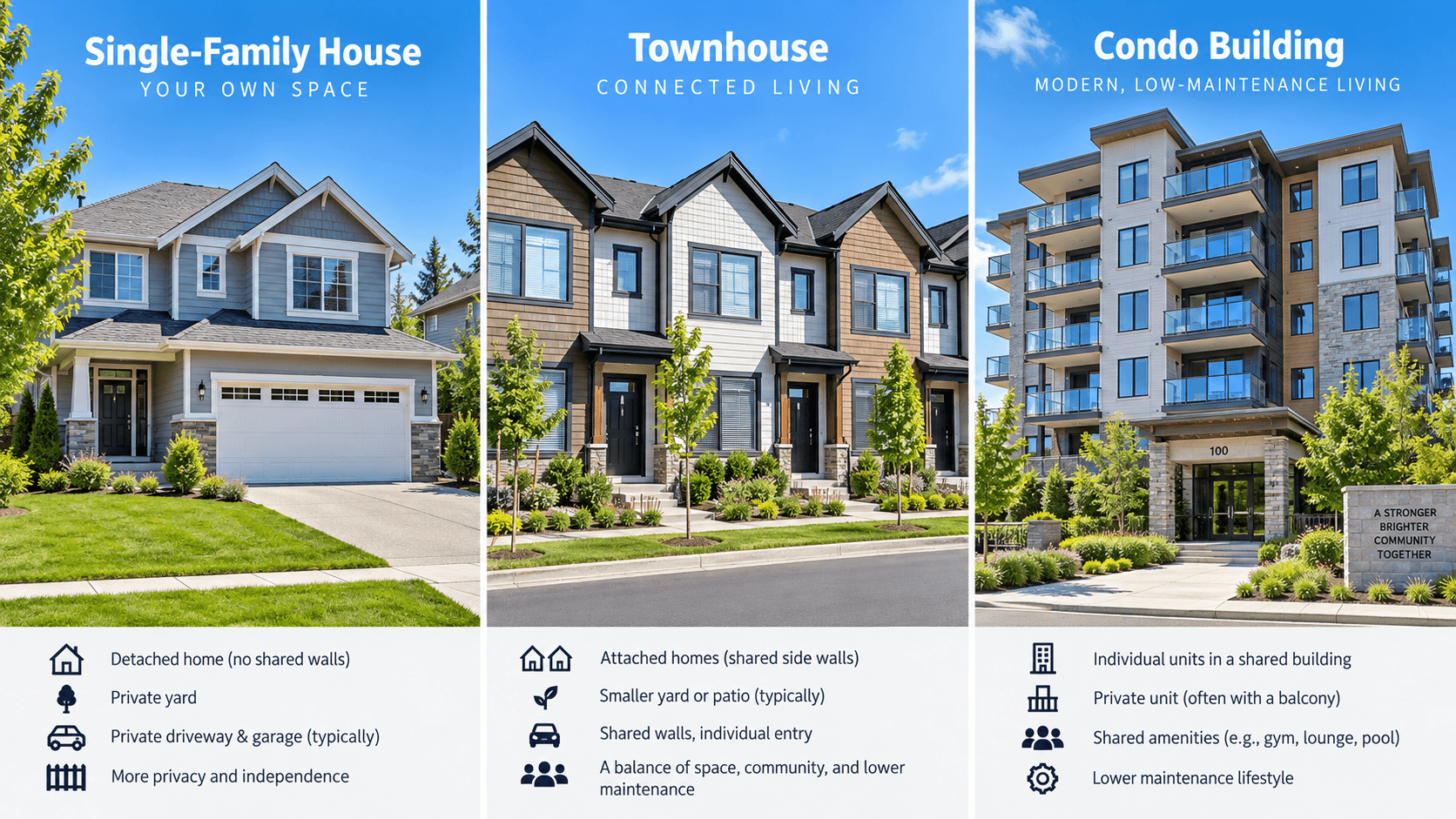
Single-family home
No shared walls. You own the structure and the land it sits on, outright, with no association owning any part of the building itself (though many single-family communities still have an HOA for shared amenities or common areas). You're responsible for the roof, the exterior, the yard — everything.
Townhouse
Shares at least one wall with a neighboring unit, but — like a single-family home — you typically own the land your unit sits on. An HOA usually maintains shared elements like the exterior, common landscaping, and any gate or amenity in exchange for monthly dues.
Condo
You own the interior of your unit. The building, the land, the roof, and the common areas are owned collectively through the condo association, and dues fund the upkeep of all of it. This is the structure most common in mid- and high-rise buildings.

Why this actually matters when you buy
Financing. Some lenders apply extra scrutiny to condo loans — reviewing the condo association's finances and reserves — that doesn't apply the same way to a townhouse or single-family purchase.
Maintenance responsibility. In a condo, exterior repairs are almost always the association's job. In a townhouse, it depends on the community — read the HOA documents. In a single-family home, it's on you unless an HOA specifically covers it.
What you can change. Owning the land under your home (townhouse, single-family) generally gives you more say over what happens to your unit than owning only interior space (condo), though HOA rules still apply in all three.
Price. Generally, single-family homes cost the most for comparable square footage, and condos the least, with townhouses in between, though this varies a lot by market and by the specific community.

Which one fits you?
If you want the most control and the most space, and don't mind the maintenance, single-family is the traditional answer. If you want land ownership with lower maintenance and often a lower price, a townhouse—like the Marlow or Saltwater at The Domaine at SoSo — is worth a look. If you want the lowest-maintenance option and don't need land ownership, a condo might fit.
How appreciation tends to differ
Appreciation patterns aren't guaranteed for any property type, but the general pattern in most markets is that single-family homes on more land tend to hold value differently than attached homes, which can appreciate faster in walkable, in-demand neighborhoods and slower in oversupplied ones. A condo's appreciation is often tied closely to the building's overall health and reserves, since a poorly maintained building can drag down every unit's value regardless of how well you've kept your own space. None of this is a guarantee in any direction—talk to a local agent about the specific submarket you're considering.
Rental rules differ by structure, not just by community
It's a common assumption that townhouses are easier to rent out than condos, but that's not really about the structural category—it's about what each specific HOA or condo association allows. Some condo associations restrict rentals tightly; some townhouse HOAs do the same. Never assume rental flexibility based on whether something is called a condo or a townhouse. Read the specific community's governing documents.
A simple way to think through the decision
If you're choosing between the three, it can help to rank what matters most: land ownership, maintenance load, price, and walkability or density of the area. A single-family home wins on land ownership and control. A condo wins on hands-off maintenance. A townhouse, like the Marlow or Saltwater at The Domaine at SoSo, sits in between—land ownership without the same maintenance burden as a detached home. None of the three is universally right; it comes down to which trade-offs fit your life.
A worked example
Imagine three otherwise comparable new-construction options in the same part of West Palm Beach: a 2,500-square-foot single-family home, a 2,200-square-foot townhouse, and a 1,400-square-foot condo. The single-family home will typically carry the highest price and the most personal maintenance responsibility, but also the most control and land ownership. The condo will typically carry the lowest price and the least maintenance responsibility but the least control over the building itself. The townhouse usually lands in between on every one of those dimensions—which is exactly why it appeals to buyers who want land ownership without full-scale maintenance.
One more thing worth asking: pet and rental policies
Whichever structure you're considering, pet restrictions and rental policies are set at the community level, not by the structural category. If either matters to you, ask for the specific HOA or condo association's current rules before assuming anything based on whether a place is called a condo, a townhouse, or a single-family home.
The role of a buyer's agent in this decision
Whichever structure you land on, a local buyer's agent who knows the specific submarket can be genuinely useful here—not just for negotiating, but for pointing out community-specific quirks in HOA documents, flood zone status, or resale patterns that aren't obvious from a listing sheet. This is true whether you're looking at a single-family home, a townhouse, or a condo, and it typically costs you nothing extra since the seller or builder usually covers the buyer's agent commission.
Checking the legal structure, not just the marketing name
Occasionally a community marketed as a "townhouse" is technically structured as a condominium form of ownership, or vice versa — the marketing name doesn't always match the legal filing. Ask your closing attorney or title company to confirm the actual legal structure of any specific community before you assume based on how it's advertised.
Common Questions
Which is cheaper: a condo or a townhouse?
It varies by market, but condos are often priced lower per square foot than townhouses in the same area, partly because you're not buying land ownership. Compare specific listings rather than assuming.
Do townhouses have lower HOA fees than condos?
Not necessarily — it depends on what each association covers. A townhouse HOA covering less (just exterior and grounds) may cost less than a condo association covering an entire building, elevators, and shared systems, but every community is different.
Can a townhouse be part of a condo association?
Yes, in some cases — the physical style (attached, multi-story) and the legal ownership structure (condo vs. fee-simple) are technically separate things, though most townhouses are set up as fee-simple ownership.
Is a single-family home always detached?
Yes, by definition — no shared walls with another home is what makes it single-family.
Which is easiest to finance?
Single-family homes and most townhouses typically go through standard financing. Condo loans can involve extra review of the condo association's finances, which occasionally adds time or complexity.
Do all three types come with an HOA?
Condos always do. Townhouses almost always do. Single-family homes vary — some are in HOA communities, many aren't.
Ready to see how a new-construction townhouse compares in person? See The Domaine at SoSo or call 561-704-0091.