Living in Lake Worth, FL — what it's actually like
In this article
"Lake Worth doesn't feel like the rest of Palm Beach County, and that's the point for a lot of people who move here. Here's what daily life actually looks like.
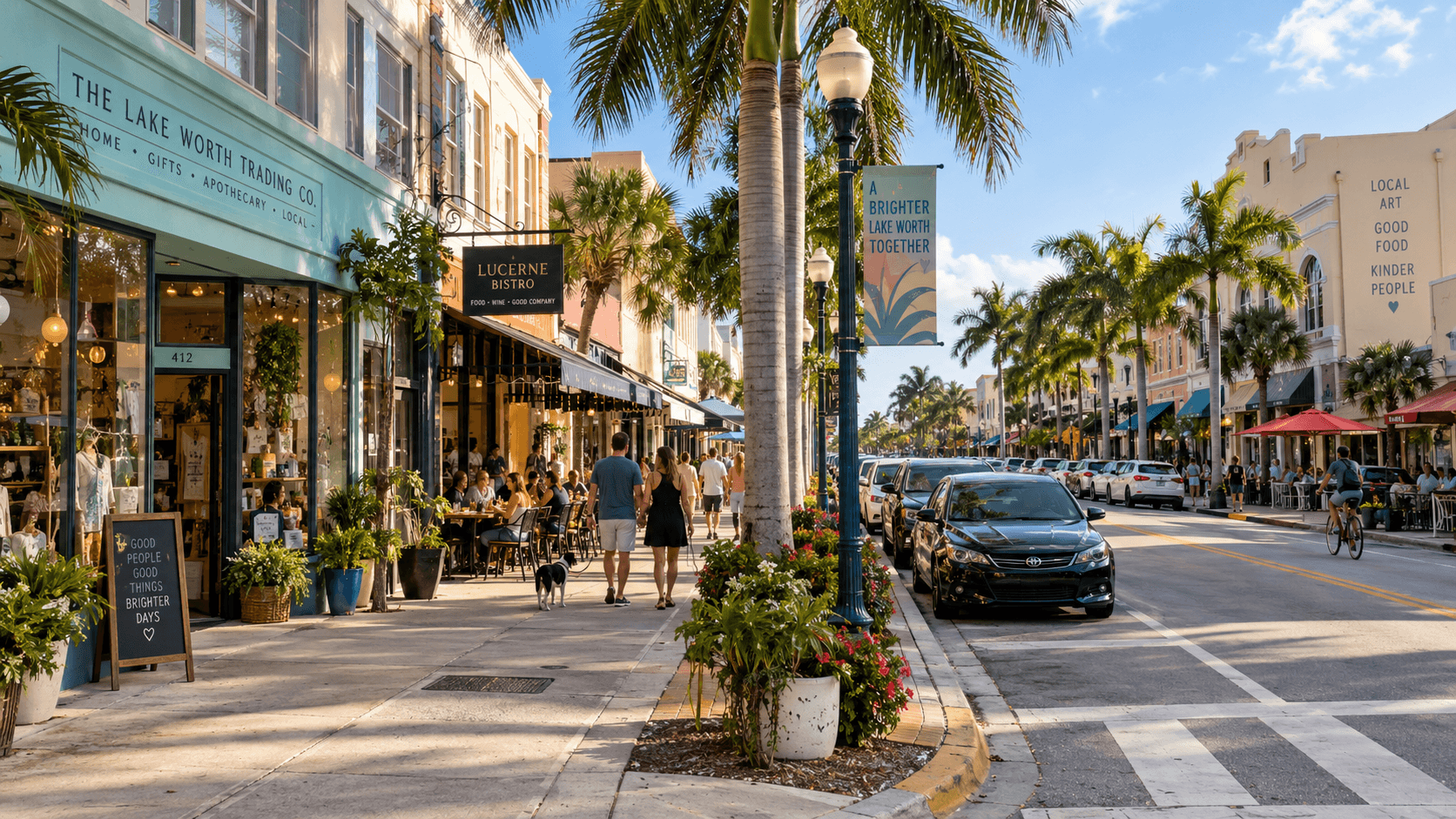
The downtown that still feels like a downtown
Lake and Lucerne Avenues form the real center of the city — walkable, lined with independent restaurants and shops, home to the Lake Worth Playhouse, which runs performances year-round. It's a different feel than the more manicured, master-planned stretches of Palm Beach County to the north and south. Storefronts here tend to be independently owned rather than national chains, and the streetscape has the kind of mixed architectural character that comes from a downtown built up gradually over decades rather than planned and constructed all at once.
The city also has a genuine arts identity — beyond the Playhouse, Lake Worth hosts a regular street painting festival and supports a visible community of working artists, something you don't typically find in newer planned communities built primarily around residential product.

Water on both sides
The Intracoastal Waterway runs along the city's eastern edge, with beach access a short drive away. To the west, Lake Osborne offers fishing, boating, and jet skiing for residents who want water access without the Intracoastal price tag. The Lake Worth Municipal Pier extends out into the Atlantic and is a popular spot for fishing and simply taking in the water, and the beachfront itself includes public parking and access points that don't require residency in one of the immediately adjacent coastal communities.
Who actually lives here
Lake Worth's population is genuinely mixed — a multi-generational base of longtime residents alongside a growing number of newer arrivals drawn by the walkable downtown and relative affordability compared to coastal cities immediately to the north and south. A meaningful share of the workforce commutes via I-95 to Boca Raton or Fort Lauderdale for work, while others work locally in healthcare, education, retail, and the hospitality businesses that the downtown corridor supports. That mix shows up in the city's day-to-day feel — it doesn't read as a bedroom community built entirely around commuters, nor as a resort town built entirely around visitors.
New construction changes the equation
Much of Lake Worth's existing housing dates back to the mid-20th century — charming, but often carrying the maintenance issues that come with 60-plus-year-old roofs and electrical systems. New communities like Forest Townhomes are a genuinely different option: modern construction, current codes, and a builder warranty, without leaving the city's character behind. For buyers who've specifically wanted to live in a walkable, established Florida city but have been discouraged by the maintenance realities of the available resale inventory, new construction closes that gap for the first time in years.

A city still changing
Lake Worth has been in a gradual transition for much of the past decade, with the downtown corridor seeing new restaurants and small businesses open alongside longtime fixtures, and with renewed attention to the waterfront and municipal amenities. New construction like Forest Townhomes is part of that broader trajectory — bringing new residents and new housing stock into a city that was, for a long stretch, defined primarily by its older housing and didn't have a genuine new-construction option at all.
Getting oriented in the city
Lake Worth is compact enough to get a feel for relatively quickly once you know its basic layout. Dixie Highway and Federal Highway run roughly north-south through the eastern part of the city, connecting to neighboring Lantana and West Palm Beach. Lake Worth Road runs east-west, forming one of the city's main commercial corridors and connecting the inland residential areas — where Forest Townhomes sits — to downtown and, eventually, the coast. For a newcomer, spending a weekend driving these main corridors is usually enough to build a working mental map of how the city fits together.
Year-round versus seasonal life
Like much of South Florida, Lake Worth sees a seasonal rhythm — busier in the winter months as seasonal residents and visitors arrive, quieter in the summer heat. Downtown restaurants and the Playhouse's programming both reflect that seasonality to some degree, though unlike some of the more tourist-oriented coastal towns nearby, Lake Worth maintains a genuine year-round resident base that keeps the city functioning outside of peak season, rather than feeling empty once the winter crowds leave.
Comparing Lake Worth to neighboring cities
Buyers relocating to Palm Beach County often cross-shop Lake Worth against neighboring cities like Lantana, Greenacres, and West Palm Beach itself. The honest distinction: Lake Worth offers a more walkable, historically rooted downtown than most of its immediate neighbors, at the cost of having fewer large-scale new-construction communities than areas further west. West Palm Beach offers a bigger-city downtown with more employment and dining options, generally at a higher price point. Lantana and Greenacres tend to be quieter residential cities without Lake Worth's downtown arts and dining identity. None of these is objectively better — the right fit depends on whether downtown walkability and character matter more to you than new-construction density.
What's around town
Curious what's actually nearby day to day? Things to do near Forest Townhomes covers parks and recreation, our schools and shopping guide covers daily errands, and getting around from Forest Townhomes covers the roads that connect it all. If you're weighing whether new construction fits your budget here, our Lake Worth buyer's guide is the place to start.
Common Questions
Is Lake Worth the same as Lake Worth Beach?
They're used somewhat interchangeably locally, though ""Lake Worth Beach"" is the city's official name following a 2019 rename. Both refer to the same city.
What's downtown Lake Worth like?
Centered on Lake and Lucerne Avenues, with independent restaurants, shops, and the Lake Worth Playhouse — a walkable core different from the area's newer master-planned developments.
Is Lake Worth close to the beach?
Yes, the Intracoastal Waterway forms the city's eastern edge with beach access nearby, including the Lake Worth Municipal Pier.
What school district serves Lake Worth?
The School District of Palm Beach County. Use the district's official locator to confirm zoning for a specific address.
Is Lake Worth a good commute to Boca Raton or Fort Lauderdale?
Many residents commute south via I-95 for work in those areas; travel time varies with traffic.
Does Lake Worth have an arts scene?
Yes — beyond the Lake Worth Playhouse, the city hosts a street painting festival and supports a visible community of working artists.
Is Lake Worth mostly older residents or younger families?
The population is genuinely mixed and multi-generational, rather than skewing heavily toward one demographic.
How does Lake Worth compare to West Palm Beach?
West Palm Beach offers a larger downtown with more employment and dining options, generally at a higher price point; Lake Worth offers a smaller, more historically rooted downtown at a comparatively lower cost of entry.
Is Lake Worth walkable?
The downtown corridor along Lake and Lucerne Avenues is genuinely walkable; residential areas further from downtown, including Forest Townhomes, are more typically car-dependent for daily errands.
What county is Lake Worth in?
Palm Beach County, roughly seven miles south of West Palm Beach along the Intracoastal Waterway.
Ready to see Forest Townhomes for yourself? Call Simon Karim at 561-704-0091 or See what new construction looks like here."