What Are Builder Incentives?
In this article
Builder incentives are benefits a builder offers to encourage a home purchase. They may help with eligible closing costs, financing costs, or selected features. Some offers change the price. Others keep the price the same. They provide extra help or features instead.
An incentive is part of an offer with terms. It is not always cash, and it is not always available on every home. Learning the types helps you understand a sales conversation before you review a specific deal. The written offer tells you what applies to you.

What the word incentive means
In plain language, an incentive is an extra reason to consider a deal. A builder may offer help with costs or features when you buy a home that meets the rules.
You may hear words such as credit, allowance, promotion, special, or sales event. Those words can describe different plans. Ask what the offer actually does rather than treating all of them as the same thing.
A credit may pay only named costs. An allowance may apply only to selected options. An included appliance is a physical item. A lower price changes the agreed purchase figure. These are different forms of value.
Once you understand the terms, use our written builder incentive offer guide to review a real offer. That page walks through who qualifies, dates, and document checks.
Why builders use incentives
An offer gives buyers another reason to consider a home. A builder may use a special to help sell selected homes. It may also promote a new offer or seek sales within a set time.
The reason for one offer can differ from the reason for another. You cannot tell a builder's finances, the home's quality, or its future value from an offer alone. Ask about the actual home and terms.
A finished home and a home that has yet to be built may have different offers. The available features and delivery schedule can differ too. Do not assume that a friend's deal applies to the property you want.
Treat the offer as one part of the choice. The layout, location, access, ownership costs, contract, and condition still matter. An offer that does not fit your needs may have little value to you.
Closing-cost help
A closing-cost offer is help toward allowed costs of completing the purchase or loan. The offer should say what can be paid and how the credit is applied.
Closing costs and the down payment are different parts of a purchase. Do not assume a builder credit supplies your down payment or becomes cash after closing. Ask the lender how the offer works with the proposed loan.
The amount you can use may differ from the stated limit. The offer, allowed costs, and loan rules all need review. Avoid using a general online percentage as the answer for your deal.
For example, an offer might name a credit toward certain charges rather than all charges. A plain question is: “Which of my costs does this credit pay?” Ask for an itemized answer from the people planning the deal.
Financing incentives
Some deals support a set loan plan. They may help with rate-related costs or other loan charges. The advertisement should be read with the loan terms and rules for who qualifies.
The interest rate tells you one part of the loan. The loan product, term, fees, points, and payment schedule matter too. A starting payment is not a full description of the obligation.
An offer may include temporary payment help or a different rate plan. Ask whether a payment changes later and why. Do not assume a low starting figure lasts for the entire loan.
The CFPB's points and lender credits guide explains the tradeoff between some upfront costs and interest rates. Use a loan officer to explain the loan terms tied to the builder deal.
This is a definition of the category. A full math of a rate offer requires the actual loan terms and your plans. Keep that deeper review separate from learning the basic vocabulary.
Option and design credits
An option credit applies to certain choices offered by the builder. It might relate to flooring, cabinets, counters, or another feature. The list of allowed choices depends on the written offer.
A design credit is not by itself money you can spend anywhere. It may be limited to a builder's selection process or named products. Ask whether unused credit disappears and whether extra choices add to the price.
Do not assume the entire model-home design is included. Display homes can have options, furniture, or finishes outside the base price. Request the feature list for the home or plan you are buying.
KB Home's base-price guide explains that some choices are included while Design Studio upgrades and loan or closing costs are separate. That is one builder's explanation, not a universal feature list.
Included items and upgrade packages
An included-item offer provides named goods or features. Examples could be an appliance package or a selected finish package. The written list should name what is included.
Ask whether the item is already part of the standard home. If it is included for all buyers at that price, it may be a standard feature rather than an extra offer for your purchase.
Both can matter to you. The point is to describe the value accurately. Do not count a standard feature once in the home's price and again as a separate cash offer.
Check the model, finish, installation, and any substitution terms when they matter. A general label such as “appliance package” may not tell you whether a refrigerator or washer is included.
Keep product coverage separate too. Our after-closing warranty records guide explains why manuals and equipment details should stay with your home files.

Price-related offers
Some offers change the price of an exact home. Others advertise a credit while the contract price stays the same. Ask which number changes in the paperwork.
A lower price and a credit are different structures. Their effects depend on the purchase and loan. Neither label alone tells you which offer fits you best.
You do not need to solve that review during your first vocabulary lesson. First name the structure: a price change, a cost credit, a feature, or a loan offer. Then gather the written details for a later review.
Do not assume a listed price includes every lot choice or option. Ask for the final price of the exact home with your selected features. That price is the starting point for understanding the purchase.
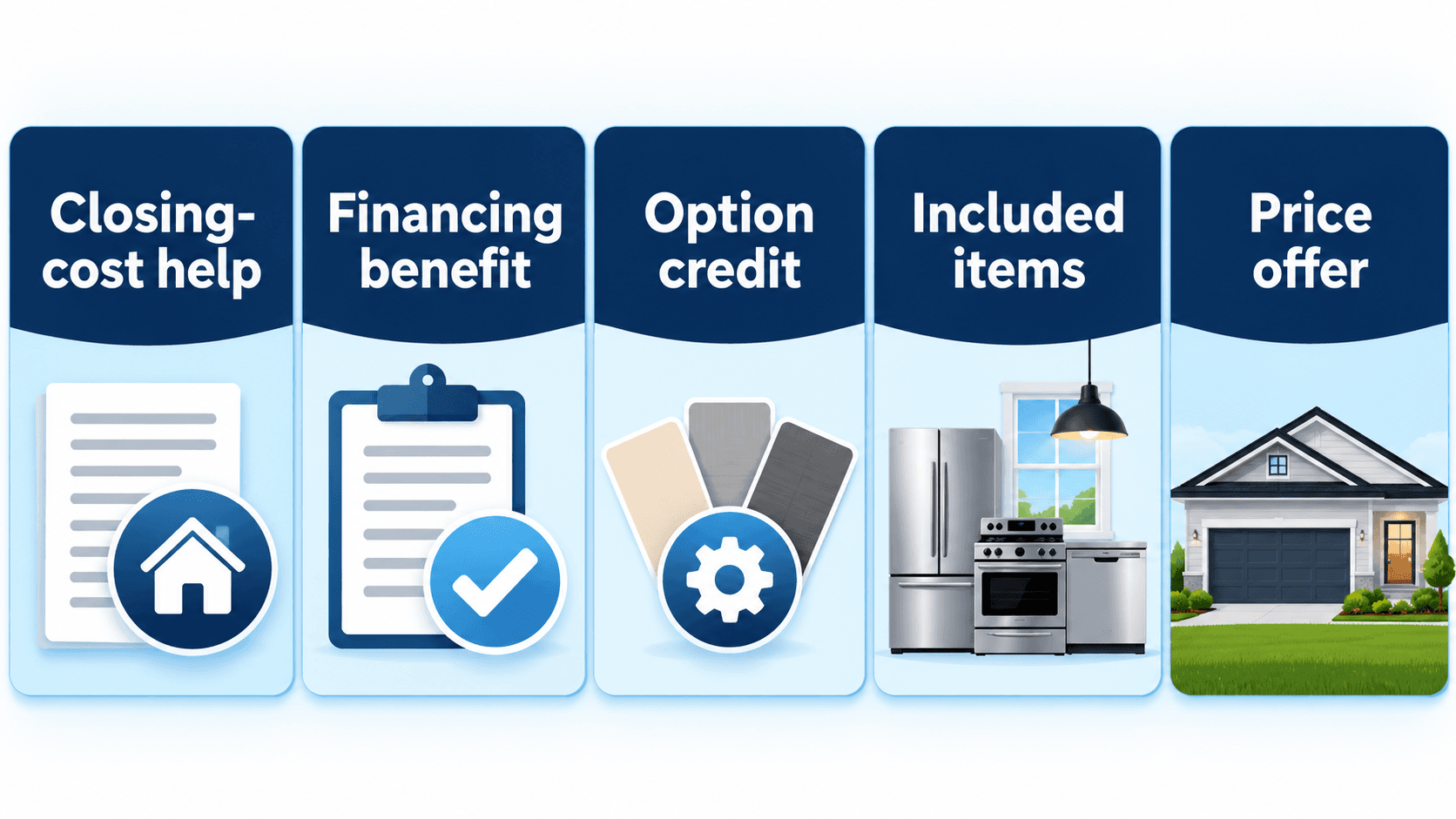
A quick guide to the main types
Type | What it may provide | First question to ask |
|---|---|---|
Closing-cost credit | Help with allowed deal costs | Which charges can it pay? |
Financing offer | Support for stated loan costs or terms | What is the full loan structure? |
Option credit | Named design or feature choices | Which choices qualify? |
Included items | Specific goods or installed features | What exactly is included? |
Price offer | A change to the home price | What is the final contract price? |
These are categories, not offers for sale. A builder may combine types or use different names. Ask the team to explain the offer using the actual documents.
For a made-up example, one offer gives a 5,000 cash available for your moving bill.
Who provides the benefit matters
The builder may pay for one part while a lender pays for another. A sales headline can place them side by side. Ask who funds and approves each part.
A builder credit and a lender credit are not by itself the same thing. They may appear differently in the deal and have different conditions. The loan officer should explain the credit on the loan documents.
Some offers need a named lender, broker, or title company. LGI Homes' official incentive page provides an example of offers with selected-home and loan conditions. Read the full terms for your own purchase.
You can still ask for a clear explanation of other choices. The CFPB's guide to choosing a loan explains how multiple Loan Estimates help buyers compare available mortgage offers.
Common words in the small print
“Select homes” means the offer applies to a defined group, not necessarily every home. Ask for the allowed address or lot. “Up to” names a maximum, not a promise that you receive that amount.
“Subject to approval” means the stated rules must be met. Ask which party checks them. “Limited time” means dates matter. Ask which event must happen by the date.
“Cannot be combined” means other offers may not stack with the offer. Ask for the exact combination you can receive. “Restrictions apply” means you need the full limits, not just the headline.
These phrases are clues to questions. They are not enough to fill in missing details. Keep a short list of unknowns and get written answers before moving forward.
What an incentive does not tell you
An offer does not establish the home's condition. Plan your independent review and allowed inspection access. Our new construction home inspection guide explains the role of that process.
It also does not describe the complete warranty. Read the signed warranty on its own. A sales offer and a repair promise serve different purposes, even when both appear in a new-home presentation.
The offer does not give you a full Florida ownership budget. Taxes, insurance, association costs, and any stated district assessment need their own review. Our Florida CDD fee guide explains one possible line in that budget.
Ask for address-exact figures from the right source. Do not use the advertised payment as your entire household housing cost without checking what it includes.

Learn the terms before touring
Before a sales visit, write down your budget, needs, and questions. You can ask whether an offer reduces allowed costs, adds features, changes the price, or affects loan terms.
Bring your own priorities into the conversation. A feature package may be useful if you want those items. A loan offer needs a loan review. An offer should help you assess the home, not decide every other part of the purchase for you.
Ask for the full written offer and take time to read it. Keep the offer with the property details so you do not mix terms from different homes. When the basic type is clear, the next review becomes much easier.
Common Questions
Are builder incentives cash gifts?
Usually they are stated benefits with conditions, such as credits or included features. Do not assume they can be taken as cash or spent on any purpose.
What types of incentives might I hear about?
Common categories include closing-cost help, financing benefits, option credits, included items, and price offers. The actual choices depend on the builder and home.
Is an included appliance always an incentive?
No. It may be a standard feature already included in the price. Ask whether it is an extra promotional benefit or part of the normal feature list.
Does up to mean I receive the full amount?
No. It names a maximum. Your usable benefit depends on the offer, eligible costs, qualification, and other stated conditions.
Are incentives the same on every home?
Do not assume so. Offers may apply only to selected homes, buyers, loan choices, or dates. Get the terms for the exact property.
What should I do after learning the incentive type?
Request the complete written offer. Then check the amount, permitted use, eligibility, required services, dates, and how it appears in the purchase documents.
Want plain-language help understanding builder offers before touring Florida new homes? Call 561-704-0091 or schedule a buyer consultation with National House Search.